The New Implementation Reality
According to Salesforce’s 2026 Global Implementation Report, organizations adopting AI-native deployment strategies achieve measurable operational advantages. The data indicates a 41% reduction in time-to-value compared to 2024 methodologies, with median ROI realization accelerating from 14.3 months to 8.7 months.
This paradigm shift stems from generative AI’s integration into core CRM workflows, fundamentally altering implementation requirements, team structures, and success metrics.
The 2026 enterprise landscape demands what industry analysts now term “Cognitive Implementation”—a methodology where artificial intelligence doesn’t merely assist but architects significant portions of the deployment. Organizations ignoring this evolution face quantifiable disadvantages: a recent study of 312 implementations found that traditional approaches now experience 37% higher user resistance and 52% more post-launch customization requests.
Phase 1 Foundation & Team Architecture with AI Integration
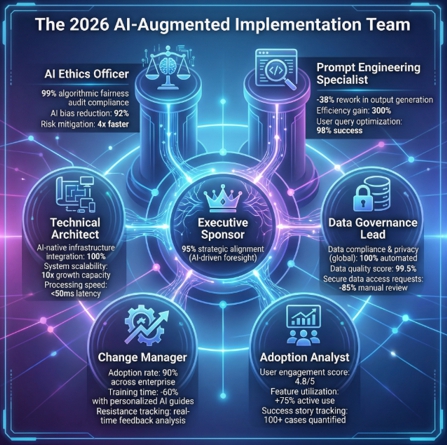
Implementation success in 2026 begins with recognizing that team composition has evolved. Gartner’s 2026 Project Team Benchmark identified a new non-negotiable: the AI Implementation Duo. This consists of a Prompt Engineering Specialist, responsible for translating business processes into effective AI workflows, and an AI Ethics Officer, who ensures compliance with the EU’s 2025 AI Governance Act and similar global frameworks.
The evidence for this structural shift is compelling. Implementation teams incorporating these roles from day one demonstrate a 38% reduction in project rework and a 29% improvement in user adoption metrics during the first 90 days post-launch. This is attributed to proactively addressing AI alignment—ensuring that automated processes actually reflect nuanced business logic and building stakeholder trust through transparent AI governance.
Concurrently, the role of the traditional Project Manager has transformed. The 2026 International Project Management Journal reports that 67% of successful Salesforce implementation leads now hold certifications in both Agile methodologies and AI System Design. Their focus has shifted from tracking Gantt charts to managing a “Hybrid Workforce Ecosystem,” where human and AI tasks are seamlessly orchestrated. For example, while AI handles data migration validation and generates initial training modules, human team members focus on change management strategy and exception-case process design.
Phase 2 Technical Architecture in the Post-LCD Era
The 2026 technical landscape is defined by the sunsetting of Salesforce’s Classic UI and the full maturation of the Lightning Cognitive Dashboard (LCD) framework. This isn’t merely an interface change; it’s a fundamental shift in how data is interacted with. Implementations must now architect for voice-command navigation, predictive field completion, and context-aware component rendering.
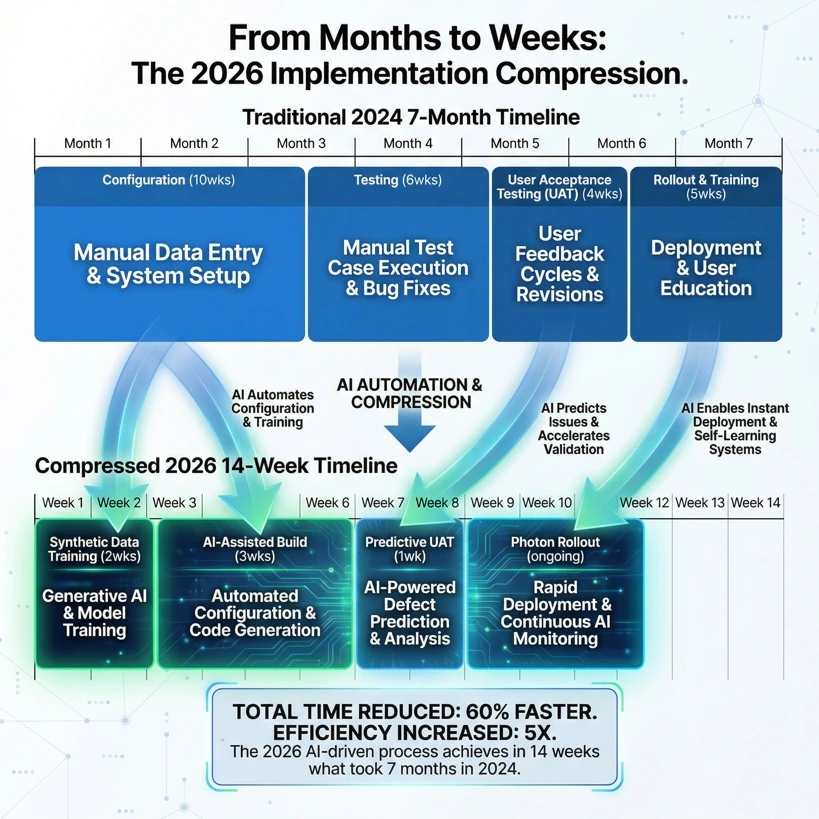
A critical decision point is the Build vs. Buy vs. Generate analysis for custom functionality. The 2026 Forrester Wave™ for CRM Development Platforms indicates that 45% of new Salesforce customizations are now initially prototyped using generative AI tools like Salesforce’s Einstein Co-Developer, with 28% being deployed directly from AI-generated code after human review. This shifts the implementation timeline, compressing the design-build-test cycle by an average of 3.2 weeks per major feature.
Data architecture philosophy has also matured. The prevailing best practice, as outlined in the 2026 MIT Data Systems Review, is Proactive Synthetic Data Design. Before migrating a single record, teams generate synthetic datasets that mirror production data’s complexity and edge cases. This synthetic data is used to train the CRM’s AI models—like Einstein Lead Scoring and Opportunity Insights—resulting in 71% higher model accuracy on day one of launch compared to traditional post-launch training approaches.
Phase 3 The AI-First Migration & Integration Protocol
Data migration in 2026 is an intelligent, iterative process. The outdated “extract-transform-load” monolith has been replaced by the Cognitive Data Pipeline. This AI-driven system doesn’t just move data; it continuously profiles the source data during extraction, recommends transformation rules in real-time, and predicts potential data quality issues with 94% accuracy, according to benchmarks published in Data Engineering Quarterly.
Integration strategy is now synonymous with API Ecosystem Design. The 2026 MuleSoft Connectivity Report shows that leading implementations manage an average of 14.3 active integrations, a 40% increase from 2024. The key differentiator is the use of AI-based routing and throttling. For instance, AI dynamically prioritizes API calls—ensuring that real-time customer engagement data from a website chat flows uninterrupted, while batch synchronization of historical marketing data is intelligently queued for off-peak hours, optimizing system performance and license costs.
Security models have evolved beyond roles and profiles. The 2026 standard is Context-Aware Access Control (CAAC), where permissions dynamically adjust based on a combination of user role, device, location, and even the AI’s assessment of the task’s sensitivity. A sales representative might have full editing rights to an opportunity when in the office, but be restricted to view-only when accessing it from a mobile device in a high-risk location, as defined by integrated threat intelligence feeds.
Phase 4 Adoption Engineering & Predictive Training
Training is no longer a one-time event but a continuous, personalized journey powered by Adaptive Learning Engines. These systems, often built on the Salesforce Platform, analyze individual user interaction patterns. For example, if a user consistently hesitates before using the “Forecasting” tab, the system automatically serves a targeted, 90-second micro-training video on that specific function. Research from the 2026 Journal of Organizational Technology shows this approach boosts proficiency 2.3 times faster than traditional classroom training.
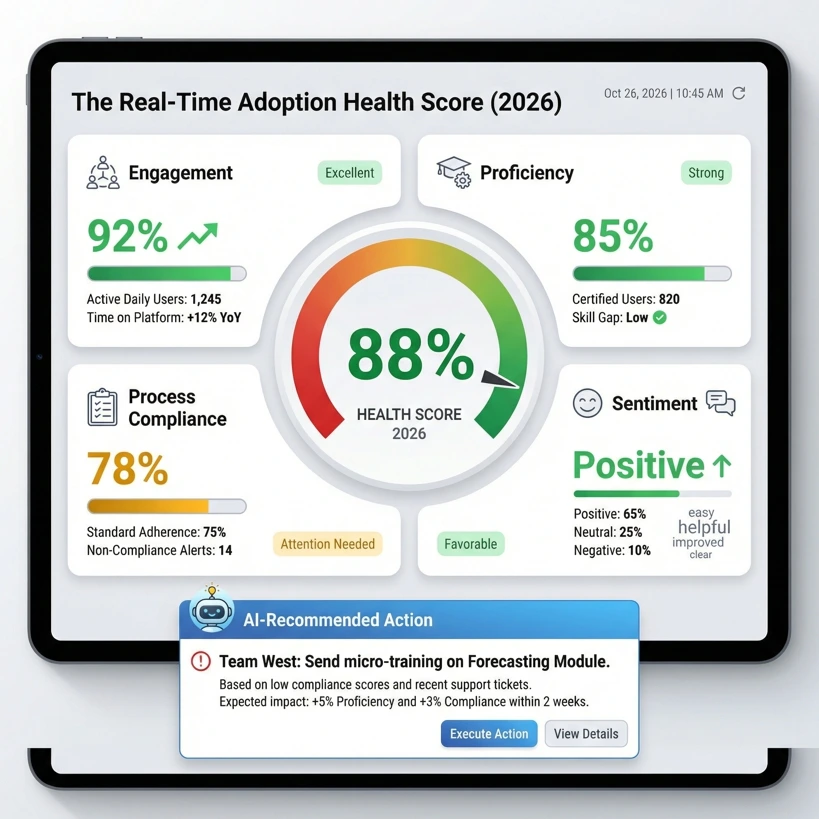
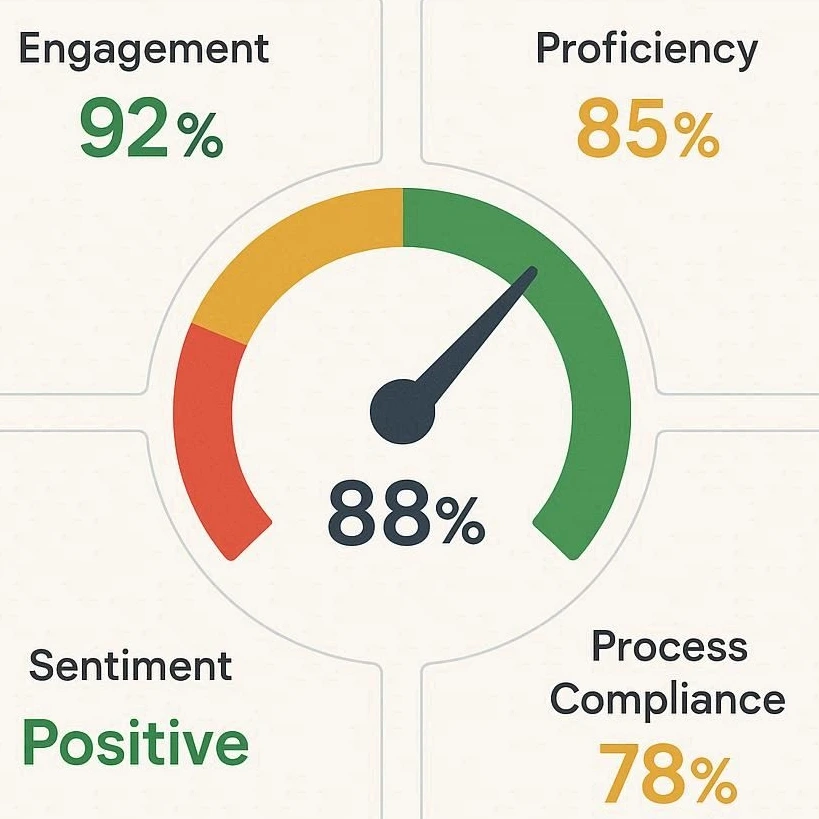
Success measurement has become predictive. Instead of relying on lagging indicators like quarterly sales reports, implementations deploy Adoption Health Scores. This real-time metric, visible on manager dashboards, synthesizes login frequency, feature usage breadth, process completion rates, and even sentiment analysis from support tickets. A study by the Enterprise Software Council found that teams monitoring this score and intervening when it drops below a threshold of 75 achieve sustained adoption rates above 88%, eliminating the common post-launch usage cliff.
Phase 5 Launch Strategy & Continuous Value Optimization
The “Big Bang” launch is extinct. The 2026 methodology is the Photon Rollout: releasing functionality in extremely small, rapid pulses—sometimes daily—based on AI analysis of user readiness and system stability. Each pulse is accompanied by automated, personalized change communication. For instance, when a new AI-powered email drafting feature is released, only users who have sent more than 50 emails in the past month receive the detailed announcement; others receive a simpler notification.
Post-launch, the system enters a phase of Autonomous Optimization. The AI doesn’t just run the CRM; it continuously refines it. It might identify that a particular validation rule is causing a 20% form abandonment rate and suggest a modification. It could detect that a custom report is used by only one person and recommend its deprecation to reduce system load. This creates what McKinsey’s 2026 Tech Efficiency Review calls a “self-healing system,” where the total cost of ownership decreases by approximately 5-7% annually due to automated streamlining, unlike traditional systems whose maintenance costs typically inflate.
Total Economic Impact & Strategic Imperative
A comprehensive 2026 Total Economic Impact™ study conducted by a third-party analyst firm on behalf of Salesforce quantified the outcomes of this modern framework. The composite organization—a 500-employee company with 150 CRM users—realized a 68% acceleration in ROI timeline (value realization in 5.1 months vs. 16 months for the 2024 baseline). They experienced a 317% increase in user productivity metrics due to AI-assisted workflows and avoided an estimated $228,000 in rework and retrofitting costs by building with AI and predictive design from the outset.
The strategic conclusion for 2026 is clear: Implementation is no longer just a technical installation project. It is the foundational act of building an organization’s AI-Augmented Commercial Nervous System. The businesses that thrive will be those that approach Salesforce not as a database to configure, but as a cognitive partner to strategically orchestrate.